
August 2026 Market Commentary from Team Provision
Key Takeaways from Team Provision
- Economic growth and hiring have moderated, but corporate earnings remain exceptionally strong, a divergence that LPL Research describes as slower expansion rather than recession.
- Market leadership is broadening. Through July, the S&P 500 index gained 10.1 percent while an equal-weighted basket of the Magnificent Seven declined 3.6 percent, with sectors like energy and community banks posting even stronger returns.
- Artificial intelligence investment is entering a new phase. Hyperscalers are projected to spend more than 750 billion dollars on AI infrastructure in 2026, potentially exceeding 1 trillion dollars in 2027, and investors are increasingly focused on who converts that spending into an actual return.
- Valuations remain elevated, which means future returns will likely need to come from earnings growth rather than further expansion of market multiples.
- Provision’s positioning remains constructive, diversified, and selective, favoring durable earnings and quality businesses alongside meaningful fixed income allocations.
Where We Are Today
The investment backdrop has become more complicated, but not necessarily less constructive. Economic growth and hiring have moderated, inflation remains above the Federal Reserve’s objective, and long-term interest rates continue to reflect both inflation uncertainty and fiscal pressures. Yet corporate earnings remain exceptionally strong, recession indicators have not deteriorated broadly, and equity market participation has expanded beyond the handful of mega-cap technology companies that dominated returns in prior years.
That divergence defines the investment environment entering the second half of 2026. Economic momentum is slowing while corporate earnings momentum remains strong.
This distinction is important. LPL Research continues to characterize the environment as slower expansion rather than recession, supported by business investment and relatively healthy consumer activity.
Our base case remains continued economic expansion, albeit with a narrower margin for error. We would become more defensive if labor weakness began translating into materially higher unemployment, weaker consumption, and deteriorating credit conditions. That sequence has not yet developed.
Inflation, the Federal Reserve, and Interest Rates
Inflation remains the principal constraint on monetary policy.
Earlier this year, geopolitical disruption produced a sharp but ultimately temporary increase in energy prices. Brent crude rose from roughly 60 dollars in late January to above 110 dollars during the height of the Middle East disruption before retreating substantially as supply concerns eased. Headline inflation followed a similar pattern, accelerating during the energy shock before moderating as crude prices declined.
The underlying inflation picture is more encouraging than the headline numbers suggest, but not sufficiently benign for the Federal Reserve to declare victory. That leaves policymakers balancing two increasingly different signals: a cooling labor market argues for less restrictive policy, while persistent inflation argues for patience.
Longer-term interest rates present a separate challenge. The Treasury curve has steepened, but unlike a traditional growth-driven steepening, much of the pressure at the long end reflects Treasury supply, term premium, and uncertainty surrounding the fiscal outlook.
Earnings Are Carrying More of the Market
The strongest argument for maintaining equity exposure is not economic forecasting. It is corporate profitability.
Second-quarter earnings have remained remarkably strong, supported by AI investment, improving cyclical activity, and resilient consumer spending. UBS entered the reporting period expecting approximately 28 percent S&P 500 earnings growth and positive profit growth across all sectors. LPL has similarly emphasized that strong corporate earnings and business investment continue to provide fundamental support for equities even as economic growth moderates.
More important than the absolute level of earnings growth is where that growth is occurring.
For much of the previous three years, investors could largely describe the market as the Magnificent Seven and everything else. That description is becoming less accurate.
Through July, the S&P 500 advanced approximately 10.1 percent, while an equal-weighted basket of the Magnificent Seven declined 3.6 percent. Meanwhile, the S&P 500 excluding those companies gained 12.9 percent, materially outperforming the headline index, and sectors like Nasdaq community banks (up 23.9 percent) and S&P 500 energy (up 35.0 percent) outpaced the broader market as well. This is not evidence that the AI investment cycle is ending. It is evidence that the earnings pool is broadening.
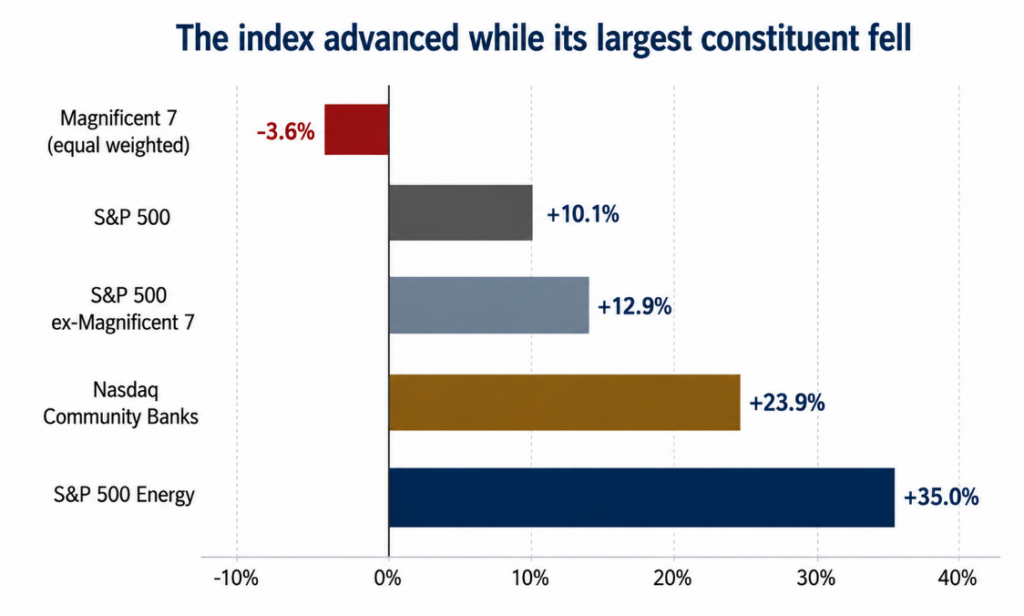
Sources: FactSet, S&P Dow Jones Indices, Defiance (XMAG), Nasdaq. Total returns through July 31, 2026.
AI: From Building Infrastructure to Earning a Return
Artificial intelligence remains one of the most powerful capital investment cycles in the global economy, but the investment question is evolving.
The first stage rewarded companies announcing increasingly ambitious AI investment programs. The next stage will increasingly distinguish between companies spending on AI, companies supplying the infrastructure, and companies ultimately monetizing it.
LPL estimates that the major hyperscalers are on track to spend more than 750 billion dollars on AI infrastructure in 2026, potentially exceeding 1 trillion dollars in 2027.
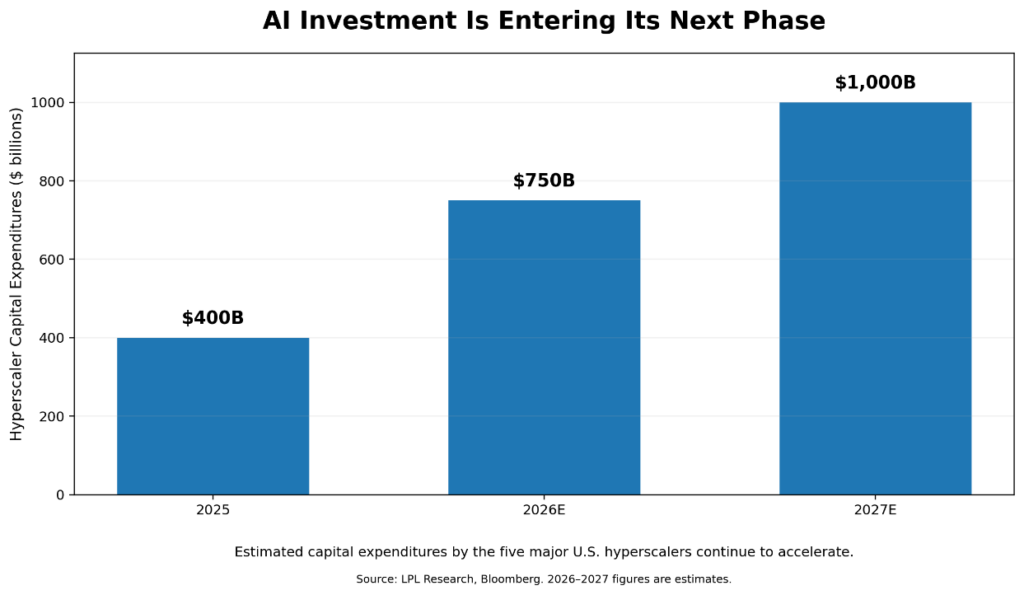
Source: LPL Research, Bloomberg. 2026 to 2027 figures are estimates.
That spending is economically significant, but capital expenditure has two sides. For the company making the investment, it creates depreciation, financing requirements, and an obligation to generate an adequate future return. For the company supplying the infrastructure, that same dollar represents revenue today.
That helps explain one of the most important rotations beneath the surface of the market this year. Capital has increasingly moved down the AI supply chain toward semiconductors, memory, electrical equipment, power generation, cooling, grid infrastructure, and other businesses required to physically build the AI economy.
We remain constructive on AI, but believe the opportunity is becoming broader and more selective. Rather than concentrating exclusively on the largest technology platforms, investors should consider the broader ecosystem benefiting from AI-related capital investment while emphasizing companies capable of funding growth internally and converting investment into sustainable free cash flow.
The next phase of AI should increasingly be measured by return on invested capital, productivity, and earnings, not capital expenditure alone.
Valuation Matters More From Here
Strong fundamentals do not eliminate valuation risk.
The S&P 500 entered the second half at elevated valuation levels, meaning future returns will increasingly need to come from earnings growth rather than another significant expansion in the market multiple.
This is where the cautious framework associated with BofA’s Savita Subramanian remains valuable. Strong companies and attractive technologies do not automatically make attractive investments at every price. The greater the expectations embedded in a security, the less room there is for execution disappointment.
LPL reaches a similar conclusion from a more constructive starting point. Its 2026 outlook explicitly argues that earnings growth, rather than additional price-to-earnings expansion, will likely need to drive the next leg of market returns.
That does not make us bearish. It makes us more selective.
We favor companies with durable earnings, strong balance sheets, defensible margins, and visible free cash flow generation. We are less inclined to pay increasingly aggressive valuations simply for exposure to a popular investment theme.
Provision View
We remain constructive on the investment environment through the remainder of 2026.
Economic growth is slowing, but the evidence does not currently support a broad recessionary conclusion. Corporate earnings remain considerably stronger than headline economic momentum, AI investment continues to support business spending, and equity leadership is expanding beyond the narrow group of mega-cap companies that dominated previous years.
At the same time, the investment environment has become less forgiving. Valuations remain elevated, inflation limits the Federal Reserve’s flexibility, and long-term interest rates are increasingly influenced by fiscal and supply considerations rather than monetary policy alone.
That combination argues neither for aggressive risk-taking nor for retreating from markets. It argues for better portfolio construction.
We favor diversified equity exposure centered on earnings durability, quality, and secular growth, complemented by meaningful fixed income allocations where current yields provide attractive income and portfolio stability.
The most important development of 2026 may ultimately be that market leadership changed without the market direction changing with it. For diversified investors, that is constructive. Returns are increasingly being generated by a broader set of companies, sectors, and economic themes.
Our positioning therefore remains constructive, diversified, and selective as we enter the second half of the year.
FAQs:
Is the U.S. economy heading into a recession? Not based on current evidence. Growth and hiring have moderated, but recession indicators have not broadly deteriorated. LPL Research continues to describe the environment as slower expansion rather than a downturn, and Provision would only shift to a more defensive posture if labor weakness began translating into materially higher unemployment or deteriorating credit conditions.
Does the slowdown in Magnificent Seven returns mean the AI trade is over? No. It signals that AI-related gains are broadening beyond a handful of mega-cap technology stocks. Through July, the S&P 500 excluding the Magnificent Seven outperformed the headline index, and capital has been rotating toward the broader ecosystem of companies building AI infrastructure, including semiconductors, power generation, and grid infrastructure.
How should investors think about valuations right now? Elevated valuations mean future returns are more likely to come from earnings growth than from further multiple expansion. Provision favors a selective approach that emphasizes durable earnings, strong balance sheets, and free cash flow generation over paying up for popular investment themes.
This material is for general information only and is not intended to provide specific advice or recommendations for any individual. There is no assurance that the views or strategies discussed are suitable for all investors or will yield positive outcomes. Investing involves risks including possible loss of principal. Any economic forecasts set forth may not develop as predicted and are subject to change. References to markets, asset classes, and sectors are generally regarding the corresponding market index. Indexes are unmanaged statistical composites and cannot be invested into directly. Index performance is not indicative of the performance of any investment and do not reflect fees, expenses, or sales charges. All performance referenced is historical and is no guarantee of future results.